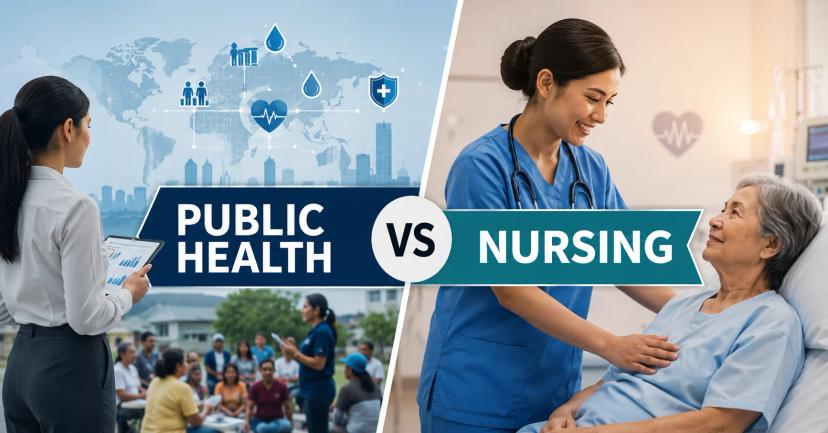

Public Health vs Nursing: Which Career Path Fits Your Goals?
The demand for healthcare professionals continues to grow, creating rewarding opportunities across hospitals, community health organizations, research institutions, and government agencies. Among the many options available, Public Health vs Nursing is one of the most common comparisons for students planning a career in healthcare.
Making the right choice starts with understanding what each career involves. This guide examines the differences in education, practical training, daily responsibilities, career opportunities, salary potential, job outlook, and work environments. It also explains who each career is best suited for, helping you make an informed decision based on your professional goals and interests.
Public Health vs Nursing Degree: Quick Comparison
Although both careers aim to improve health, they differ in their responsibilities, work environments, and career focus. You can have a full glance at both with the given table. This comparison highlights the factors that have the biggest impact on your education, daily work, and long-term career, making it easier to identify the path that aligns with your goals.
|
Comparison Factor |
Public Health |
Nursing |
|
Primary focus |
Prevents disease and improves the health of communities. |
Treats and cares for individual patients. |
|
Who you help |
Communities, organizations, and populations. |
Individual patients and their families. |
|
Daily responsibilities |
Health education, research, data analysis, program planning, and policy support. |
Patient assessment, medication administration, treatment, monitoring, and care coordination. |
|
Patient interaction |
Limited or indirect. |
Direct and ongoing. |
|
Work settings |
Government agencies, nonprofits, schools, research institutions, and corporate wellness programs. |
Hospitals, clinics, nursing homes, home healthcare, and community health centers. |
|
Work environment |
Office, field, or community-based settings. |
Clinical and hospital environments. |
|
Clinical responsibilities |
Minimal in most roles. |
Core part of the profession. |
|
Licensing |
Not required for many entry-level roles; some positions require certifications. |
RN licensure is required to practice as a Registered Nurse. |
|
Work schedule |
Mostly standard business hours, depending on the role. |
Shift-based, including nights, weekends, and holidays. |
|
Career impact |
Improves health at the population level through prevention and policy. |
Improves individual patient outcomes through direct care. |
Decision Guide:
- If you enjoy working directly with patients in clinical settings, nursing may be the better fit.
- If you're more interested in disease prevention, health education, and improving community health, public health may align better with your career goals.
Public Health vs Nursing Degree: Education, Skills, Salary, and Career Opportunities
Degrees Requirements and Coursework
For Public Health: A bachelor's degree in public health takes approx 4 years to complete and focuses on preventing disease, promoting health, and improving healthcare systems. Subjects within this field include epidemiology, biostatistics, environmental health, global health, health policy, community health, and research methods. You don't need to treat patients directly here, infact the curriculum teaches students how to identify health challenges, analyze population data, and develop programs that improve community well-being.
For Nursing: Students complete either a 2-year Associate Degree in Nursing (ADN) or a 4-year Bachelor of Science in Nursing (BSN). The curriculum combines classroom instruction with extensive clinical learning. Core subjects include anatomy, physiology, pharmacology, pathophysiology, medical-surgical nursing, pediatric nursing, maternal health, mental health nursing, and patient assessment. Graduates must also pass the NCLEX-RN licensure examination before practicing as Registered Nurses.
Read Also: Key Emerging Skills for Graduates in Healthcare Administration in 2026
Clinical Training vs Field Experience
This section can clear your mind, which may help you make the final decision on Public Health vs Nursing. The type of practical training each individual would be receiving will provide the biggest factors that will separate a public health degree from a nursing degree. You should ask yourself:
- Whether you want to work directly with patients every day, or
- Do you want to improve the health of entire communities?
A public health degree focuses on field experience rather than bedside care. Students work on community health assessments, disease prevention campaigns, health education initiatives, research projects, and internships with government agencies, nonprofits, hospitals, or public health organizations. Instead of treating patients, you'll learn how to identify health challenges, analyze population data, evaluate public health programs, and develop strategies that reduce disease and improve access to healthcare. Your success is measured by the impact your work has on communities rather than individual patients.
A nursing degree is built around clinical training. Students complete supervised clinical rotations in hospitals, clinics, rehabilitation centers, and long-term care facilities, where they apply classroom learning to patient care. During these placements, you'll assess patients, administer medications, assist with treatments, respond to emergencies, communicate with physicians, and monitor recovery. Clinical training also helps students build the confidence to make decisions under pressure while delivering safe, compassionate care.
In simple terms, public health teaches you how to prevent health problems before they affect large populations, while nursing prepares you to care for people who already need medical attention.
Career Opportunities, Salary, and Job Outlook
Each degree prepares graduates for a different type of healthcare career, with its own responsibilities, earning potential, and advancement opportunities. Reviewing the common career paths and their average salaries can help you understand which degree aligns better with your long-term professional goals.
Public Health Career Opportunities
|
Career |
Average Annual Salary |
|
Medical and Health Services Manager |
$117,960 |
|
Public Health Analyst |
$88,400 |
|
Epidemiologist |
$87,200 |
|
Health Policy Analyst |
$90,000 |
|
Environmental Scientist & Specialist |
$80,060 |
|
Global Health Specialist |
$84,000 |
|
Public Health Researcher |
$82,000 |
|
Community Health Program Coordinator |
$78,000 |
|
Health Education Specialist |
$63,000 |
|
Community Health Worker |
$51,030 |
Job Outlook: The U.S. Bureau of Labor Statistics projects 16% employment growth for Epidemiologists between 2024 and 2034, while Medical and Health Services Managers are projected to grow 29%, making healthcare management one of the fastest-growing careers in healthcare.
Nursing Career Opportunities
|
Career |
Average Annual Salary |
|
Nurse Practitioner* |
$132,050 |
|
Nurse Manager |
$120,000 |
|
Emergency Room (ER) Nurse |
$109,000 |
|
Intensive Care Unit (ICU) Nurse |
$108,000 |
|
Labor and Delivery Nurse |
$107,000 |
|
Operating Room (OR) Nurse |
$106,000 |
|
Oncology Nurse |
$101,000 |
|
Pediatric Nurse |
$95,000 |
|
Registered Nurse (RN) |
$93,600 |
|
Community Health Nurse |
$90,000 |
Job Outlook: Registered Nurses are projected to grow 5% between 2024 and 2034, with approximately 189,100 job openings each year. For nurses who pursue graduate education, Nurse Practitioners are among the fastest-growing healthcare careers, with 46% projected employment growth during the same period.
Note: Salary figures are compiled from the U.S. Bureau of Labor Statistics (BLS) for occupations with official wage data and supplemented with recent salary estimates from Indeed and Glassdoor for specialized roles that do not have separate BLS salary reporting.
Questions to Ask Yourself Before Choosing Public Health or Nursing
Reading about salaries and job duties is helpful. However, your daily work will have a bigger impact on your career satisfaction. Before you choose a degree, take a moment to answer these questions honestly.
-
Do you want to work with patients every day?
If you enjoy helping people face-to-face and want to be involved in their care and recovery, nursing may be the better choice. On the other hand, if you want to improve the health of entire communities through education, research, or health programs, public health may suit you better.
-
What kind of workplace do you picture yourself in?
Think about where you would enjoy spending most of your time. Nurses usually work in hospitals, clinics, or other healthcare facilities. Public health professionals are more likely to work in community organizations, government agencies, schools, research centers, or offices.
-
Do you enjoy quick decisions or long-term planning?
Nurses make important decisions throughout the day while caring for patients. In contrast, public health professionals spend more time studying health problems, planning programs, and finding ways to prevent illness before it spreads.
-
What kind of impact do you want to make?
If seeing one patient recover motivates you, nursing can be very rewarding. However, if you'd rather help thousands of people through better health programs, education, or policies, public health may be the right fit.
Before You Make Your Decision, Read This
It's easy to assume these careers are similar because they're both part of healthcare. In reality, they lead to very different experiences. Keep these points in mind before making your choice.
- Public health isn't just about government jobs. You can also work in hospitals, nonprofits, universities, research organizations, and private companies.
- Nursing isn't limited to hospitals. Nurses also work in schools, community health centers, home healthcare, rehabilitation facilities, and many other settings.
- A higher salary doesn't always mean a better career for you. Think about the work you'll enjoy doing every day, not just the paycheck.
- Your first job isn't your final destination. Both careers give you opportunities to specialize, continue your education, and move into leadership roles.
- Choose the career that matches your interests. You'll enjoy your work much more if it fits your strengths, personality, and long-term goals rather than simply following trends or salary figures.
Conclusion
A career in healthcare is more than a profession. It's an opportunity to improve lives, solve meaningful challenges, and contribute to the well-being of others. Both public health and nursing play essential roles in achieving this goal, but they differ in how they create that impact. Nursing focuses on caring for individuals through treatment and recovery, while public health works to prevent illness, improve healthcare systems, and create healthier communities.
As you compare these career paths, think about the work that excites you most. Do you want to care for patients face-to-face, make clinical decisions, and see the results of your efforts every day? Or would you rather develop health programs, analyze data, influence policies, and address health challenges that affect thousands of people? The answer can help you identify the career that best fits your interests and long-term goals.
Whichever path you choose, both professions offer rewarding careers, strong job prospects, and opportunities for lifelong growth. By understanding the differences in education, training, career opportunities, salary potential, and daily responsibilities, you can move forward with confidence and choose a career that aligns with the future you want to build.
FAQs
1. Which is better: Public Health or Nursing?
Neither career is better for everyone. Nursing is a better fit if you want to provide direct patient care and work in clinical settings. Public health is a better choice if you're interested in disease prevention, research, health education, policy, or improving the health of entire communities. The right option depends on your career goals and interests.
2. Which pays more: Public Health or Nursing?
On average, nursing offers higher starting salaries because Registered Nurses enter licensed clinical roles immediately after graduation. Public health salaries vary by specialization. Leadership roles such as Medical and Health Services Managers can earn well over $100,000 annually, while entry-level public health positions may start lower.
3. Is public health easier than nursing?
The two degrees have different challenges. Nursing requires extensive clinical training, patient care, and passing the NCLEX-RN licensure exam. Public health focuses more on research, data analysis, epidemiology, health policy, and community health programs. Neither degree is easier; they simply require different skills.
4. Can I become a nurse with a public health degree?
No. A public health degree alone does not qualify you to become a Registered Nurse (RN). You'll need to complete an accredited nursing program and pass the NCLEX-RN licensing examination before you can practice as a nurse.
5. Can nurses work in public health?
Yes. Many Registered Nurses work in public health departments, schools, nonprofit organizations, community health centers, and government agencies. Some nurses also earn a Master of Public Health (MPH) to move into leadership, research, or health policy roles.
6. Is public health a good career in 2026?
Yes. Public health continues to grow as healthcare systems invest more in disease prevention, population health, health education, and emergency preparedness. Graduates can find opportunities in government agencies, hospitals, research institutions, nonprofits, and private healthcare organizations.
7. Do public health professionals work in hospitals?
Yes. Although many public health professionals work in government or community organizations, hospitals also hire them for infection prevention, quality improvement, health education, community outreach, population health, and healthcare management roles.
8. Can I earn more with a master's degree in public health or nursing?
Yes. Advanced degrees can increase your earning potential in both fields. Public health graduates commonly pursue an MPH for leadership and management roles, while nurses may earn an MSN or DNP to become Nurse Practitioners, Nurse Educators, or healthcare administrators.
9. Is nursing more stressful than public health?
Nursing can be more physically and emotionally demanding because it involves direct patient care, shift work, and emergency situations. Public health roles generally have more predictable schedules, although responsibilities can become demanding during disease outbreaks, public health emergencies, or large-scale health initiatives.
10. Which degree has better job opportunities?
Both degrees have strong employment prospects, but the opportunities differ. Nursing offers a direct path into hospitals and clinical care, while public health provides careers in healthcare management, research, government agencies, nonprofit organizations, education, consulting, and global health. The best option depends on the type of work you want to do.